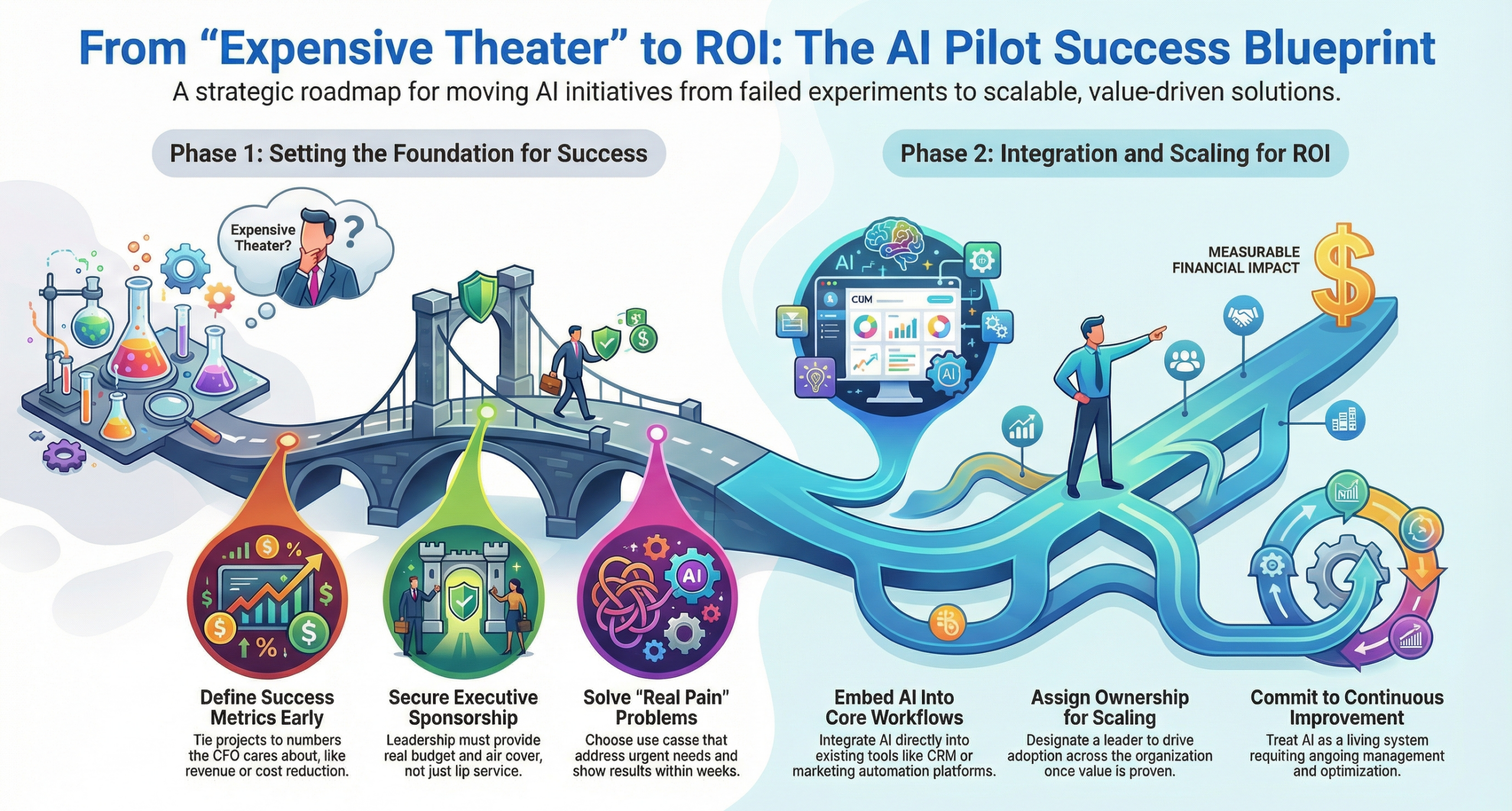
Not because the technology doesn’t work, but because experimentation without a clear path to value is just expensive theater.
I’ve seen too many organizations spin their wheels on AI “innovation” that never leaves the sandbox. They run pilots, generate excitement, maybe even get some press—and then nothing scales. No ROI. No adoption. No impact.
Here’s how to actually move from experiments to results that matter.
Define success metrics early (Or Don’t Bother Starting)
Before you launch any AI pilot, answer this question: What does success look like in numbers?
Not vague aspirations like “improve efficiency” or “enhance customer experience.” Actual metrics. Increased leads. Better conversion rates. Reduced costs. Time saved. Revenue generated.
If you can’t tie your AI project to outcomes that your CFO and CEO care about, you’re building a science project, not a business solution. Define your metrics upfront, and make sure everyone agrees on how you’ll measure ROI.
Secure executive sponsorship (because without It, you’re dead)
AI pilots without executive buy-in are doomed from the start.
You need leadership support—not just lip service, but real commitment. Resources. Budget. Air cover when things get messy. The best AI projects are aligned with strategic business priorities from day one, which means executives see them as mission-critical, not nice-to-have experiments.
If you’re trying to sneak an AI pilot through without C-suite awareness, you’re setting yourself up for failure.
Start small, but make it meaningful
The worst AI pilots are the ones that solve problems nobody actually has.
Pick a use case that addresses a real, urgent business need. Something that’s causing pain right now. Something that, if solved, would make a noticeable difference in weeks or months, not years.
And make sure it fits into actual workflows—not some isolated technical demo that requires people to change how they work. The easier it is to adopt, the faster you’ll see results.
Integrate with core business systems (or it won’t stick)
AI solutions that sit outside your core systems are science experiments, not business tools.
For measurable impact, you need to embed AI into everyday operations. Connect it to your CRM, marketing automation platform, customer support system—whatever tools your team already lives in.
If people have to leave their workflow to use your AI solution, they won’t. Integration isn’t optional—it’s the difference between adoption and abandonment.
Test, Measure, and Refine (like your job depends on it)
Treat your pilots like structured experiments, not hope-based initiatives.
State your assumptions clearly. Test them against real data. Measure outcomes using the metrics you defined at the start. And when the data tells you something isn’t working, iterate fast.
The goal isn’t to prove you were right. The goal is to learn what actually works and double down on it.
Assign ownership for scaling (because pilots don’t scale themselves)
Once a pilot shows value, the hardest part begins: scaling it.
You need a team or leader who owns the rollout. Someone responsible for managing the solution, gathering user feedback, and driving adoption across the organization. Without clear ownership, even successful pilots die in committee.
Scaling isn’t a technical challenge—it’s an organizational one. Plan for it from the beginning.
Communicate results and learnings (even the ugly ones)
Share what you learned—wins, losses, and everything in between.
Use data from your pilots to build compelling business cases for further investment. Show leadership what worked, what didn’t, and what you’d do differently next time. Transparency builds trust and makes it easier to secure resources for the next phase.
And don’t sugarcoat the failures. Organizations that learn from mistakes move faster than ones that pretend everything is perfect.
Plan for Continuous Improvement (because AI isn’t “Set It and Forget It”)
Your first pilot is just the beginning.
AI solutions need ongoing management, refinement, and optimization. Build regular reviews into your process. Monitor performance. Adjust as your business evolves. The organizations that extract long-term value from AI are the ones that treat it as a living system, not a one-time implementation.
Bottom Line
Moving from AI experiments to measurable ROI isn’t about having the fanciest technology. It’s about discipline, focus, and relentless execution.
Define clear metrics. Secure executive support. Start with meaningful problems. Integrate into real workflows. Test, measure, and iterate. Assign ownership. Communicate results. And keep improving.
Do this, and you’ll turn AI pilots into full-scale programs that consistently deliver business outcomes. Skip any of these steps, and you’ll join the pile of failed experiments that never made it out of the lab.
What’s your biggest challenge in moving AI from pilot to production? Where are you getting stuck?