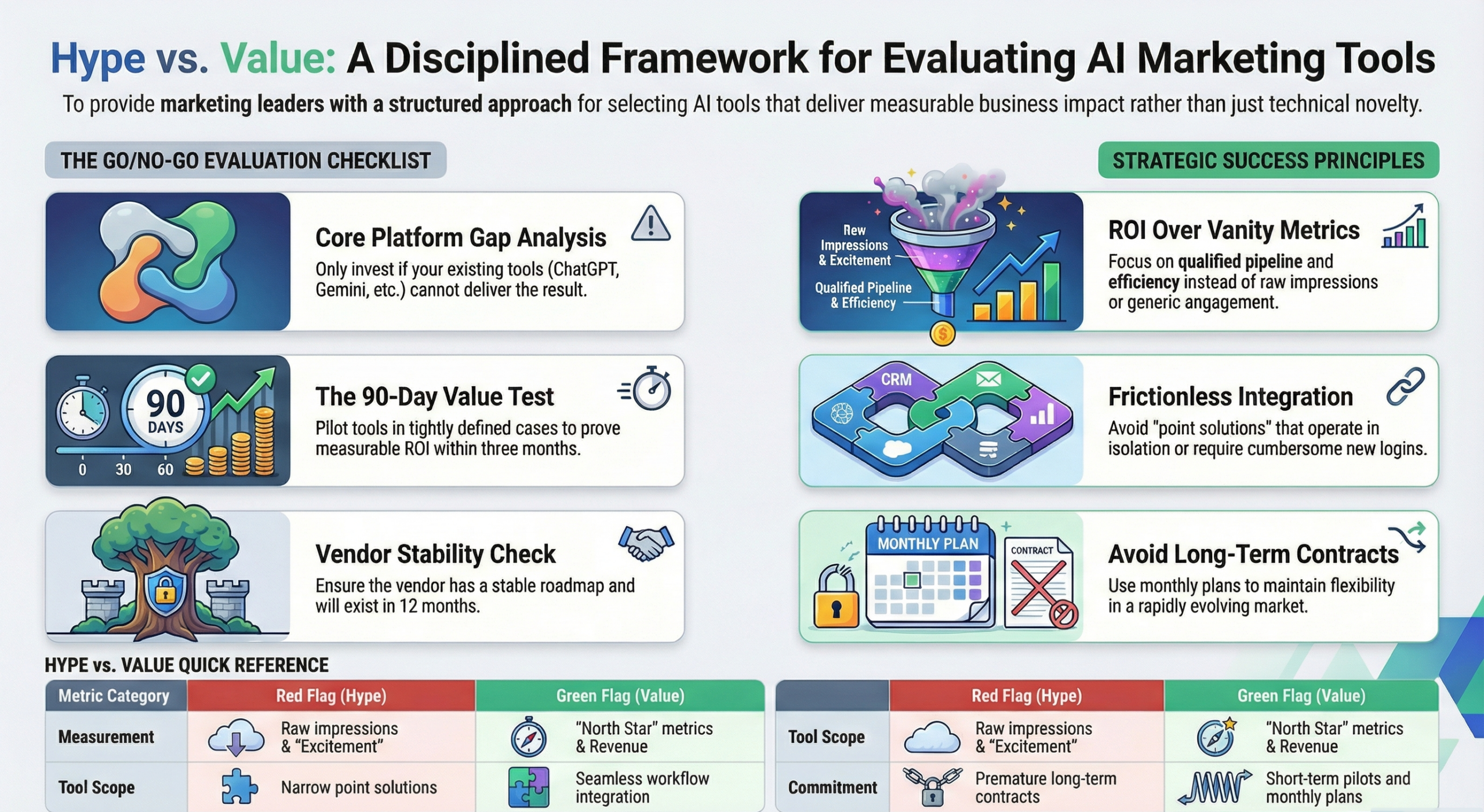
With so many AI marketing tools flooding the market, it’s easy to be swayed by shiny demos and lofty promises. But sound decision-making demands a disciplined approach.
Here’s how savvy marketing leaders cut through the noise to find tools truly worth the investment.
Start with the Basics
Focus on your foundational tools first. Most marketing teams already use powerful AI platforms like ChatGPT, Gemini, Copilot, or Claude. Before investing in specialized solutions, ask yourself: does our main platform already do what we’re considering?
If so, there’s usually no need for another tool. These general platforms tend to be more stable and easier to integrate. Don’t pay for what you already have.
Check for Fit and Integration
Evaluate how well the candidate tool will integrate with your existing workflows and tech stack. Avoid tools that operate in isolation or require cumbersome new logins—those often struggle with low adoption.
If your team won’t use it because it’s a pain to access, it doesn’t matter how powerful it is.
Vendor Viability and Security
Consider the vendor’s stability and security posture. Many AI tools are short-lived, with limited funding or minimal user bases.
Select vendors who are likely to still be supporting the product in a year, and who can clearly meet your organization’s security and compliance requirements. I’ve seen too many teams invest in tools that disappeared six months later.
Tie Every Tool to Business Outcomes
Successful teams pilot new tools in tightly defined, business-critical use cases. Here’s a typical approach: run a 90-day trial, focusing on a measurable goal such as time saved, increased campaign performance, more qualified leads, or streamlined workflows.
Before you start, decide how you will measure success. Pick one North Star metric, track your starting baseline, and measure improvement. No baseline, no way to prove value.
Rely on ROI Calculators
Many organizations use explicit ROI calculators or estimators early in the evaluation process, especially to quantify time savings and revenue impact.
This keeps the focus on tangible benefits rather than excitement or novelty. Excitement fades. ROI doesn’t.
Go Beyond Vanity Metrics
Avoid easy-to-impress measures like raw impressions or generic engagement stats. Instead, focus on whether the tool moves the needle for qualified pipeline, meaningful engagement, or brand preference.
If it’s not impacting revenue or efficiency in a meaningful way, it’s not worth it.
Red Flags to Watch Out For
If your core AI platform can already accomplish the task, there’s rarely a need for a more expensive add-on.
Carefully consider the level of change management or training required. Tools that are difficult to use often fail to gain internal traction.
Point solutions—those with very narrow use cases—are especially risky, as larger vendors may soon offer the same features natively.
Vendor instability or lack of a clear roadmap is a major reason to say no, regardless of feature set.
A Practical Evaluation Checklist
Use this framework before committing:
Your core platform can’t deliver the needed result. If ChatGPT or your existing tools can do it, stop here.
The vendor’s trajectory and product roadmap appear stable. Are they funded? Do they have real customers? Will they exist in 12 months?
You can measure ROI or impact within 90 days. If you can’t prove value quickly, it’s probably not there.
The tool slots easily into existing workflows and has champions within your team. Adoption is everything.
There is real evidence of improved quality, cost savings, or work your team couldn’t do before. Not just “nice to have”—actual impact.
People will actually use it. Test with real users, not just a pilot sign-up list.
Don’t Commit Long-Term Prematurely
Given how fast this field is evolving, long-term contracts are rarely a good idea. Start with shorter pilots or monthly plans so you can walk away if promised results don’t materialize.
The market is changing too quickly to lock yourself in.
Frameworks and Approaches
Teams often apply a prompt structure to AI evaluations, defining the Goal, Role, Action, Context, and concrete Example before proceeding. It’s also helpful to prompt the AI to challenge assumptions and suggest alternative approaches, ensuring no single answer guides adoption uncritically.
Finally, use the same key metrics over time to benchmark the tool’s impact against existing processes and competitors, enabling year-over-year comparisons.
The Bottom Line
The marketing technology space is awash in bold claims and rapidly changing capabilities. The only sure way to separate value from hype is to make every tool prove itself, through a rigorous process that connects technical features directly to the business metrics that matter.
Run tightly scoped pilots. Document results. And remember—if there’s no measurable improvement, don’t hesitate to step away.
Too many teams fall in love with demos and forget to measure outcomes. Don’t be one of them.
How do you evaluate new tools? What’s your go/no-go framework? I’d love to hear what’s working for you.